

In trying to stay busy over summer break, I have found myself cleaning. One of my newfound chores, alongside mopping, dusting, and pressure washing, is the time-tested, truly American pastime of lawn care. Once a week, I pop my AirPods in, turn on a narrated version of the latest Current Affairs article, and spend the subsequent two hours reigning in the green that surrounds my house (with intermittent breaks for water and to dump out the grass bag).
However, as the summer has progressed, my mowing runs have become, much like the interstate, a significant degree more stop-and-go. The culprit? Apis mellifera—more commonly known as the honey bee. They love the swaths of white clover that populate my backyard, and as a result, I am forced to pause every thirty seconds or so and wait for one of the little guys to bumble away, lest it meet the fate of some of its less lucky brethren in service of an inch-tall, perfectly green monoculture.
It’s safe to say that at least five had met their untimely demise, at which point I began to stop wondering how I could avoid them, and instead, a much broader question: Why are we Americans so obsessed with our lawns—and is that still acceptable?
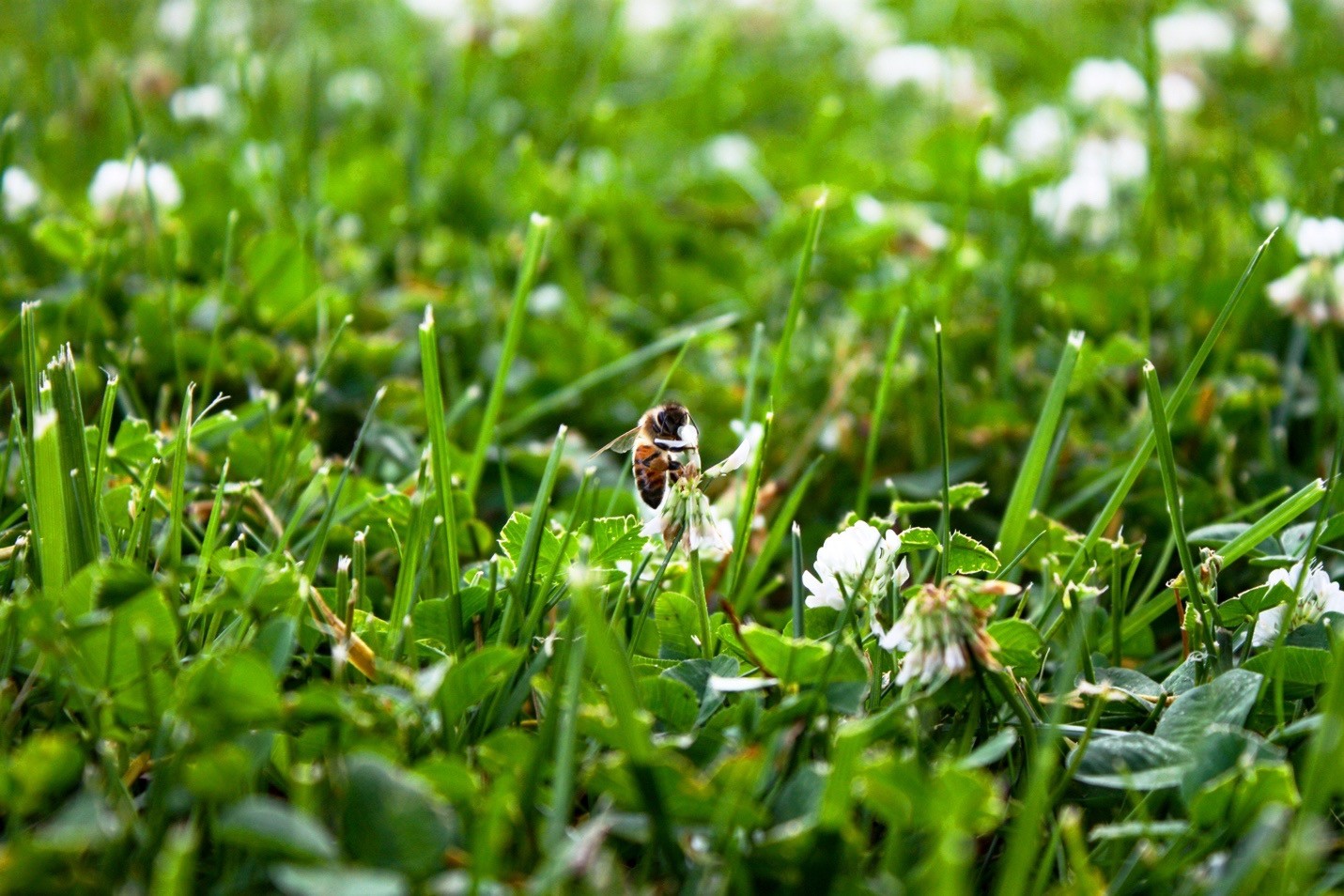
I was putting these guys' lives at risk—and for what?
When you look out at a typical American “white picket fence” suburb, it may fill you with a sense of pride. A belief in a country that ensures anyone, regardless of their background, can achieve a better life through hard work and determination. A couple, able to sustain life with two children and a dog on a single salary, able to afford a house in a quiet neighborhood, topped off with a pristine, uniform, emerald-green carpet of weed-free turfgrass.
According to a 2005 study published in Environmental Management, manicured lawns cover more than 40 million acres of the United States—an area larger than Georgia—making grass the single largest irrigated crop in the country. Surely this must be the American dream in action, right?
In fact, that landscape is not American-born. It was imported from colonial Europe. The grasses that make up this massive green carpet, like Kentucky Bluegrass, Perennial Ryegrass, and Fescues, are entirely non-native, introduced to the United States by early colonists for livestock grazing as early as the 1600s.
In 1776, the concept of the “lawn” had yet to propagate in the soon-to-be States. Colonists were busy fighting a war, after all, and grass was seen as purely a utility—there was no time to maintain it. But while that may have been true for the average colonist, the same could not be said for George Washington and Thomas Jefferson. Both were obsessed with European landscaping and sought to recreate the sweeping "pleasure grounds" and manicured estates of the European aristocracy. Swaths of green sent a clear message that the landowner was wealthy enough to burn both time and resources on land that couldn’t be eaten. Although that’s not to say either were personally out in their fields, maintaining their imported aesthetic—estates like George Washington's Mount Vernon required the intense and repetitive labor of enslaved African Americans, who scythed the grass by hand.
An expansive lawn was the 18th century’s American Express Black Card—representative of highly exclusive wealth, denied to the common man. That is, until the invention of the mechanical mower by an English engineer named Edwin Beard Budding in the 1830s. Riverside, Illinois, widely considered one of America’s first planned suburban communities,mandated that each home be set back 30 feet from the street, creating one connected, communal, and most importantly, attainable front yard.
However, no suburb will ever compare to that of Levittown, New York—Levitt & Sons’ blueprint of the modern American suburb, which popularized the "American Dream" of suburban homeownership, defined by its weed-free, closely cropped, monoculture lawn.

Levittown's sprawling, open format, characterized by its lack of fencing
The Levitt family viewed landscaping as a means of “neighborhood stabilization,” or a way of protecting property value, so codified in property deeds of the 17,000 homes built was a stipulation that required homeowners to mow “at least once a week between April 15th and November 15th of each year.” Fall behind, and you could face fines, liens, and social stigma—a barrier to entry barely on the radar of wealthier homeowners who could hire landscapers (or lawyers).
But as American middle-class life modernized and urbanized, so did their methods for lawn maintenance. Just merely mowing and weeding was not enough. The perfect lawn could not be achieved organically—no. It must be engineered.
Traditional lawns are considered ecological "dead zones" because their composition of non-native grasses provides neither food nor shelter for local wildlife and decimates local biodiversity. However, their inability to properly integrate into our country’s ecosystem does serve the benefit of one creature: capitalism.
The O.M. Scott & Sons Company capitalized on the postwar consumer idea of the "perfect green lawn" as a status symbol to market both fertilizers and herbicides to the suburbs, becoming a dominant force in both consumer weed-and-feed products.
But while these products were marketed to the average consumer, it was an open secret that these lawns were pretty much denied to “any other persons than members of the Caucasian race.” In fact, that exclusion clause is taken directly out of Levittown’s original 1948 leasing agreement.
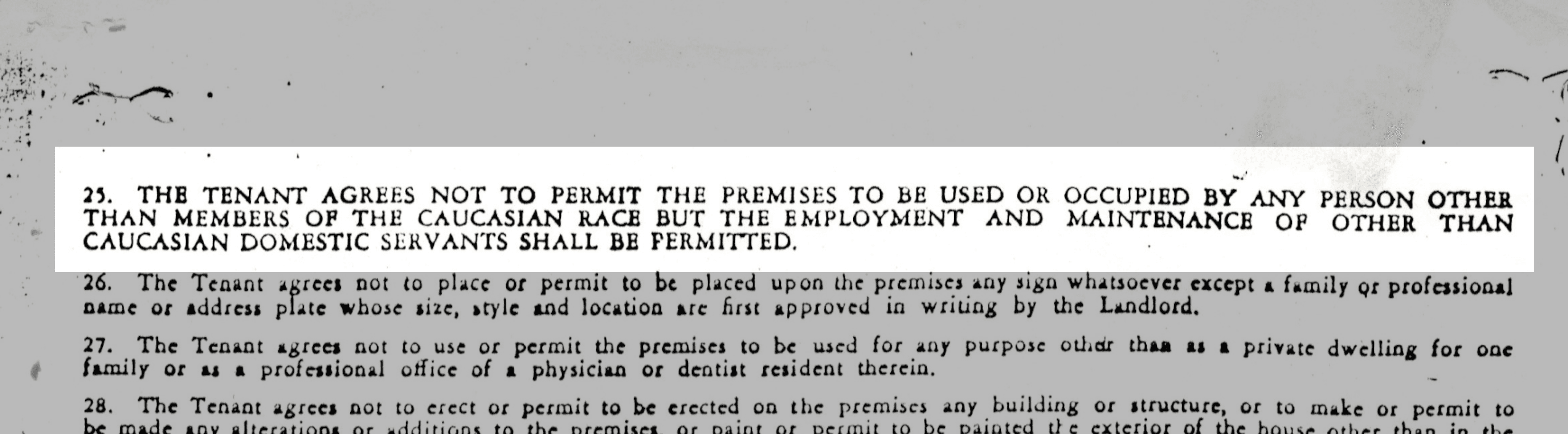
The infamous "Clause 25" was a blatant display of racial segregation.
The lawn ideal was built on a racially segregated foundation, and this wasn’t unique to Levittown. Around the same time as the mechanical lawnmower was taking off, General Sherman's Special Field Order No. 15, issued January 16, 1865, confiscated 400,000 acres of Confederate land, stretching from Charleston, South Carolina, to Jacksonville, Florida, to be redistributed to freed Black families. This directive, also known as "40 acres and a mule," was, however, revoked by Andrew Johnson following President Lincoln's assassination.
More than 1,200 people who received land had it taken back after their former enslavers protested, shattering the prospect of generational land wealth for Black Americans at the exact moment it could have been established—and just as the American suburban ideal began to realize.
The value of that broken promise lies somewhere around $640 billion and $14 trillion.
51 years and a 5-hour flight later, you’ll find yourself in Berkeley, California. It’s 1916 now; racism is still all the rage (what a shocker!), and the future of the movement is being spearheaded by real estate developer Duncan McDuffie, who is credited with building our nation's very first exclusionary single-family residential zone classification. He, much like the Levitts, used explicitly racist covenants to enforce segregation in his own developments.
...As extra assurance for buyers seeking a permanent, high-quality exclusive neighborhood, '[o]nly persons of the Caucasian race... except servants' could live there. McDuffie began recording such covenants in Claremont Park in Berkeley in 1905. […] Such restrictions were a crucial “shield,” McDuffie explained, “permanently protecting…homes and stabilizing and increasing…land values. … They deny entrance to undesirable neighbors and…inharmonious houses.[ES2] ”
Here’s what set him apart, however: McDuffie was the first to invent a public zone that outlawed anything except a single-family house on a single lot.
In 1916, when California passed the City Planning Enabling Act, Berkeley's mayor appointed McDuffie as Chair of the Berkeley Civic Arts Commission, the body tasked with developing the city's planning framework. He publicly stated that his mission was to "utilize the precedent of private restrictions to create public zoning"—he wanted the government to legally enforce the same race-based discrimination he had built into his private developments, anticipating they would eventually strike down his explicit racism.
When the Supreme Court did in 1917, developers used his single-family zoning as a technically legal proxy to achieve the same result by banning cheap, multi-family housing, duplexes, apartments, and commercial stores, effectively pricing out the minority families he had no intention of renting to.
When the FHA was established in the 1930s, it institutionalized these private-sector practices through its official Underwriting Manuals, which advised appraisers to rate neighborhoods poorly if they contained "incompatible racial and social groups," explicitly stated that "a change in social or racial occupancy generally contributes to instability and a decline in values," and warned against the "infiltration of inharmonious racial groups."
Yet, legally, these families should still have been able to enter these neighborhoods—what was stopping them?
Disagree with our framing? Pitch a counter-perspective.
culture