
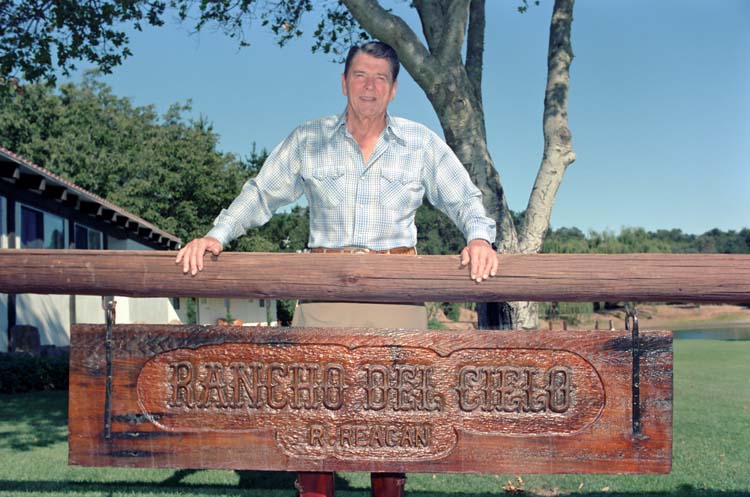
Before winning the presidency by a historic landslide, Ronald Reagan was a B-list Hollywood actor who starred in a handful of Western films, such as Law and Order and Santa Fe Trail. Outside the confines of Hollywood, just two and a half hours north, he ran a 688-acre mountain retreat called "Rancho del Cielo," Spanish for “Ranch in the Sky,” at which, during his two terms, he spent roughly 350 days. Together with his political rhetoric of “pulling oneself up by the bootstraps” and the idea that individual initiative and “horse sense” are the keys to the American Dream, these helped cement his identity as that of the lone, self-sufficient cowboy.
In his remarks at the opening of “The American Cowboy” exhibit at the Library of Congress in 1983, Reagan said the following: “This exhibit can remind those of us who work or visit here what America is all about. If we understand this part of our history and our continuing fascination with it, we will better understand how our people see themselves and the hopes they have for America.”
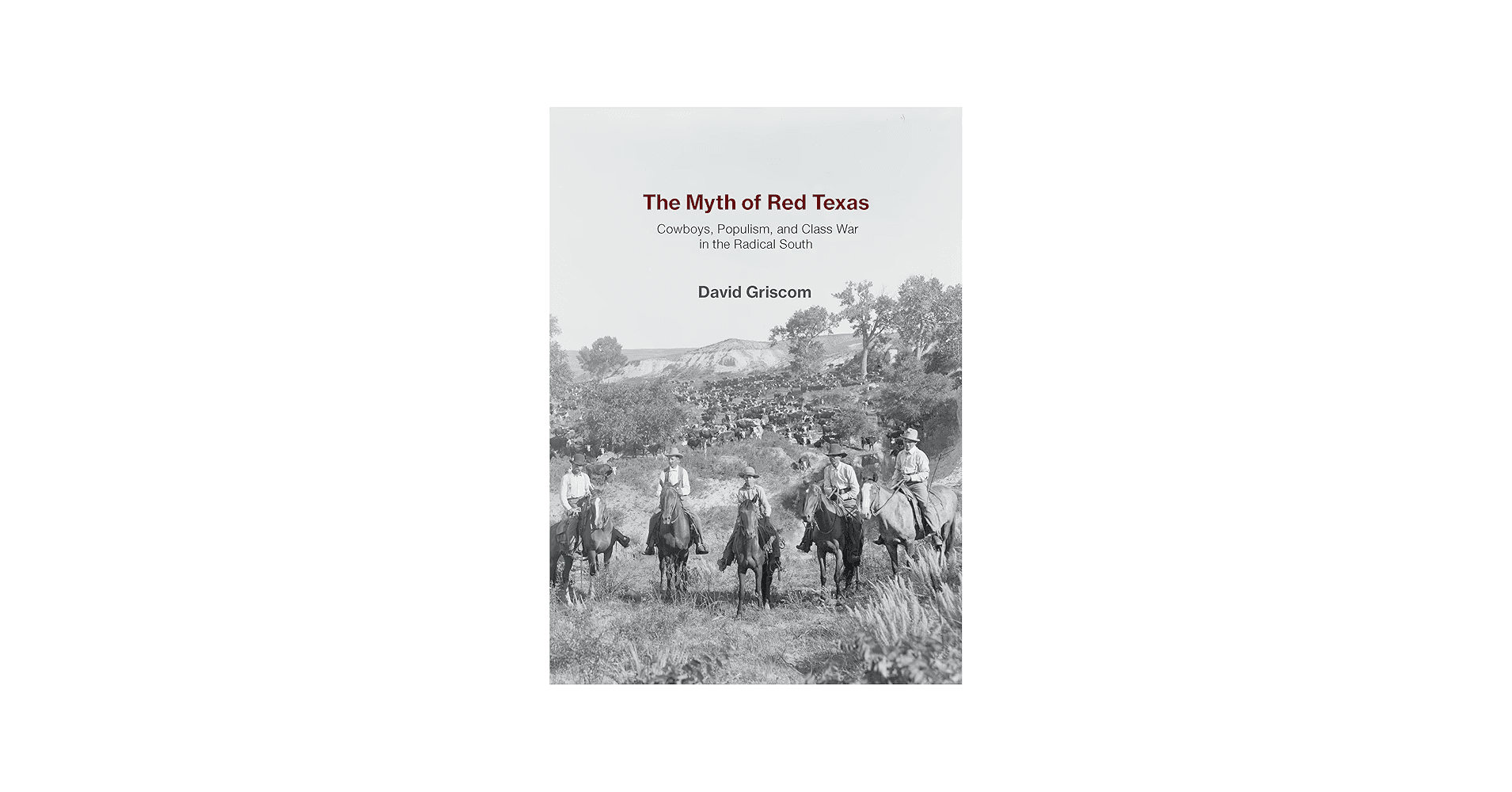
In his debut book under Nation Books, a progressive publishing imprint formed as a joint venture between The Nation magazine and independent publisher OR Books, David Griscom challenges the assumption that Texas has always been a naturally conservative, right-leaning stronghold by uncovering the state’s roots in radical left-wing populism, socialism, and workers’ rights movements that some would like us to forget.
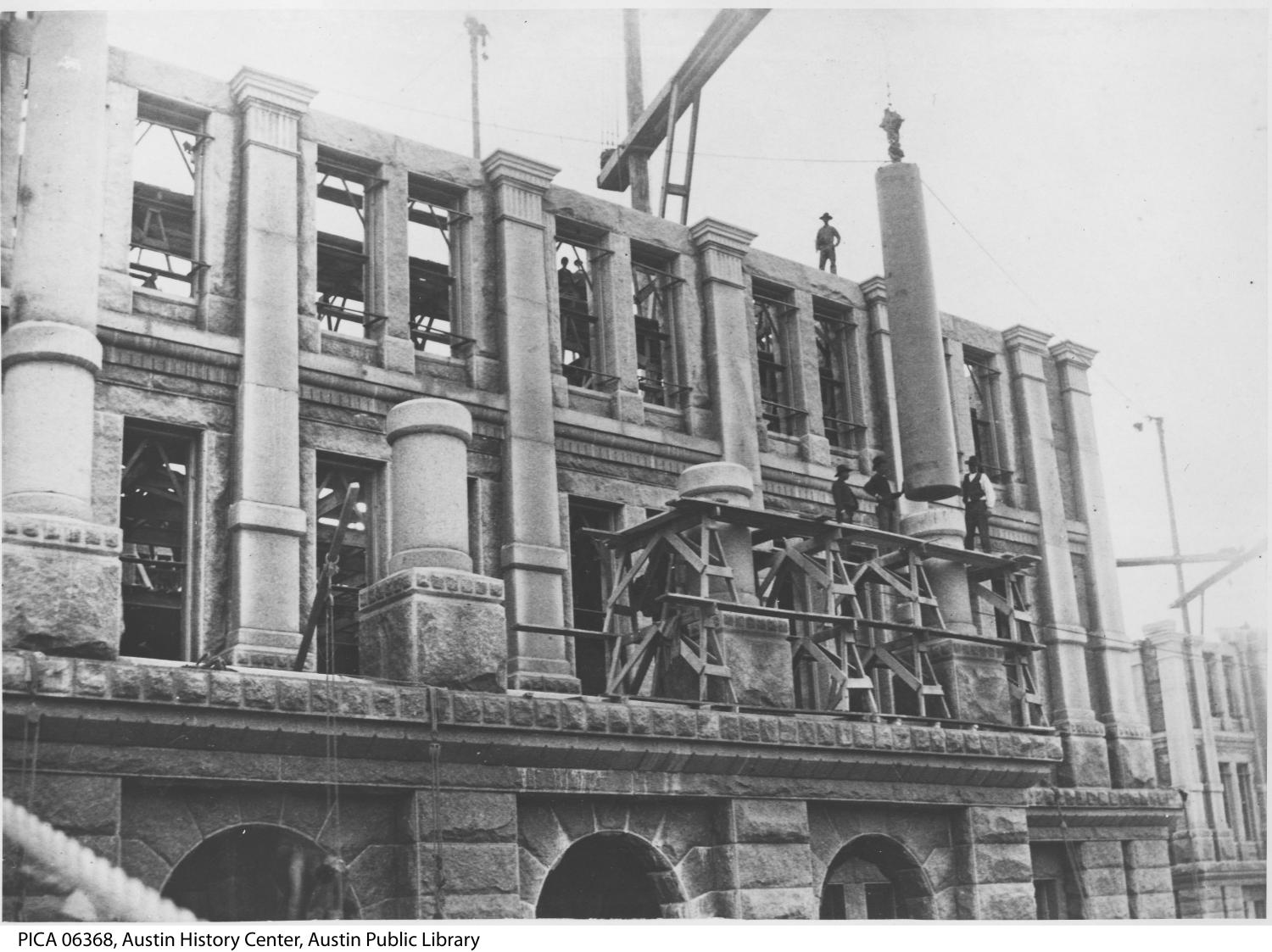
The introduction to The Myth of Red Texas: Cowboys, Populism, and Class War in the Radical South opens with a classic example of state-backed labor suppression in Texas: “To keep costs down, the state government also leased some five hundred convict laborers for the [construction of the Texas State Capitol]. Naturally, this pissed off the local unions, who had been asked to oversee the building’s construction. They refused to help with the project, at which point [out-of-state investors] turned to foreign scab labor as a substitute. […] People can point to the Capitol and say, ‘Labor loses in Texas.’ The story goes that Texans prefer conservatism, so-called states’ rights, and personal independence.”
Texas is a “right-to-work” state, a name deliberately chosen to obfuscate its true purpose. Right-to-work laws prohibit contracts that require all workers in a unionized workplace to pay union dues or fees—even if the union must legally represent them, a policy specifically designed to defund and weaken unions by draining their resources until the union either collapses or becomes toothless.
In fact, Texas has quite a long history of union busting, and one of the ways it justified the ruthless suppression of the workers who built (and continue to build) our nation was by redefining what the great cowboy once stood for: “Republicans in Texas have been skillful at crafting a version of Texas history that is favorable to their current goals. And they are not afraid of using their political power to enforce this narrative.”
Ask almost anyone, even outside of the South, to picture a cowboy, and the image they’ll paint will go something like this: a lone man, riding horseback out into the sunset, surrounded by a herd of cattle, pockets full of coins won in a few hands of off-the-books poker.
To this fictional person’s credit, at the time, cattle were a common sight in Texas, and cowboys made a living partaking in a tradition known as “mavericking.” Cowboys could claim unowned cattle, known as "mavericks," and allow them to graze with their employer's herd. This offered cowboys a chance to start their own herd, providing an opportunity to climb the economic ladder in the cattle industry. However, this created competition in the markets, and the out-of-state capitalists cared little for tradition, forcing cowboys to abandon the practice and work only for a wage, and a low one at that.
“Cowhands quickly understood these changes brought on by the ranch bosses would mean they could never get ahead. Cowboying was a young man’s game, and without mavericking, low-wage work would mean their end. So instead of competing amongst each other, they created an association and promised to bargain for wages together, across all of the significant cattle ranches in the region,” Griscom writes.
Sounds a lot like socialism, if you ask me. (A political and economic theory advocating collective ownership and administration of the means of production and distribution of goods.)
The Myth of Red Texas demonstrates how, actually, cowboys were some of the first labor organizers. They didn’t operate alone—no. Instead, they worked together to fight for fair wages and the public ownership of Texas’ vast land. When the Northern and European capitalists dominating the state’s economy constructed miles of barbed wire, “blanketing their slice of grassland,” they “fenced so much land that they often cordoned off roads, schools, and waterways, which were public.” By cutting off the flow of water, they rendered the land upstream worthless, swooping in to buy it at dirt-cheap rates, effectively putting an end to the idea that “the open range was part of the commons [and] that the land and water belonged to the people.” So, organized into secret vigilante groups, the cowboys cut the fences. One rancher found a bullet-torn note that read, “If you don’t make gates, we will make them for you.” Another found a freshly dug grave and a noose, with a note reading, “This will be your end if you rebuild this fence.”
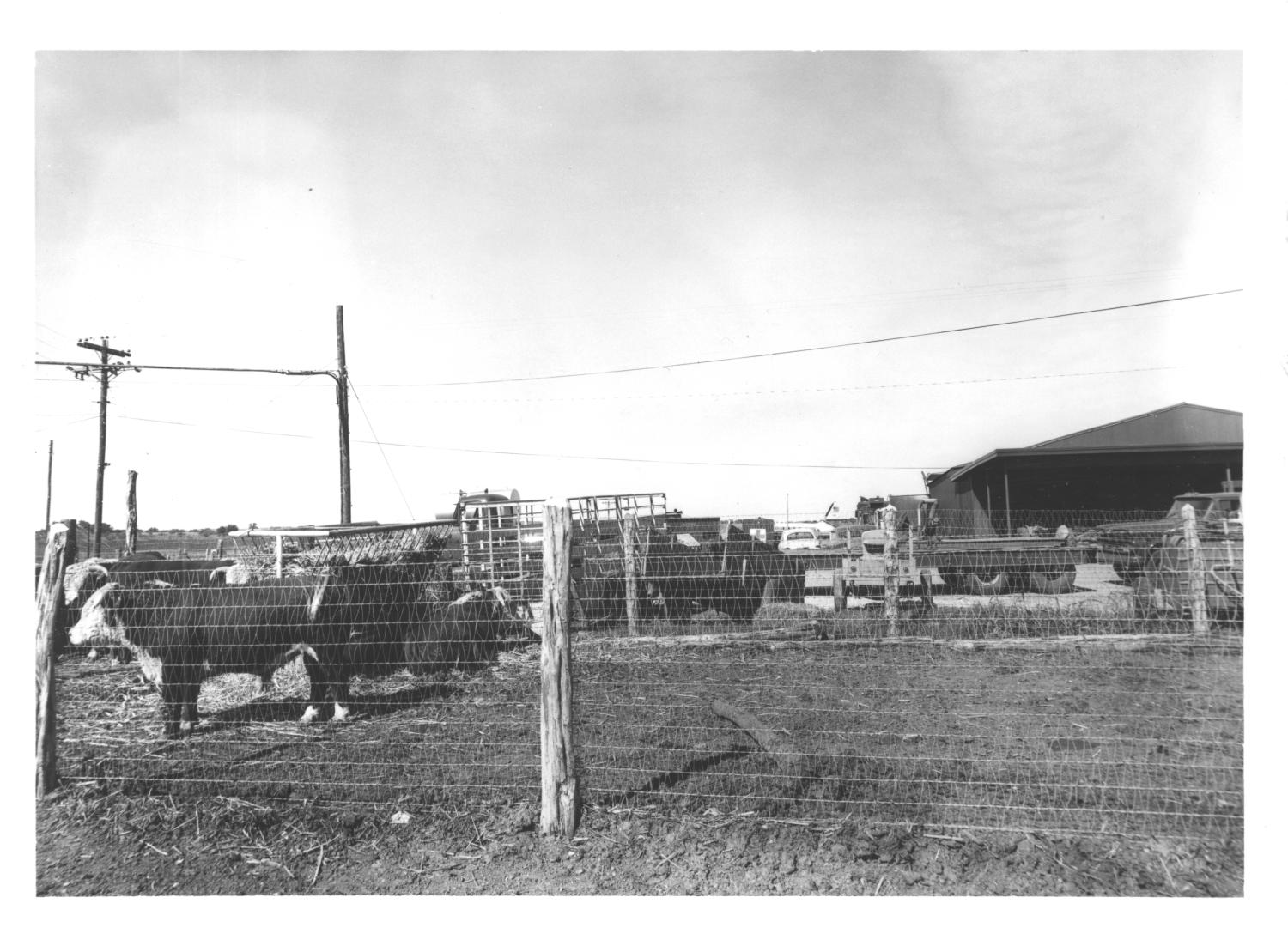
In response, these landowners did not cease their campaign of privatization. Instead, they colluded with local and state law enforcement to push through legislation, making fence cutting a felony punishable by five years. Legislation which was enforced by Texas Rangers who took a “morbid pleasure” in the chase: “In the summer of 1888, Sergeant Ira Aten and Jim King were sent to Navarro County to crush fence cutting. […] As they gained their fellow farmers’ trust, they eventually found intel on the fence cutters, at which point Sergeant Aten began collecting dynamite. His intention was to rig the fences to explode when cut, blowing his newfound acquaintances to smithereens.”
Those very same cowboys participated in something that, if Texan leadership could have their way, very well might be illegal if replicated today: the Cowboy Strike of 1883. While some would have you believe that the strike was a failure, in reality, the U.S. Commissioner of Labor reported that it was a success, resulting in a forty-two percent increase in wages for the cowboys and involving three hundred and twenty-eight cowboys across the Texas Panhandle, making it both the first and largest organized labor walkout in the history of the cattle industry. That hardly sounds like a failure. As put by Griscom, “the belief that working people banding together to take on the power of concentrated wealth wasn’t the result of some foreign agitation or romantic dream of idealists. It was a homegrown, practical response to the abuses of a creeping form of capitalism that would forever change the state of Texas.”
And the Cowboy Strike isn’t just an isolated incident—Texas has a long history of collective bargaining, such as the work done by the Farmers’ Alliance. The Alliance, which would eventually grow to have three million members, had humble beginnings. Farmers were poor, simple as that. They often had little cash but still needed supplies to produce cash crops like cotton, so they depended on credit and used their harvest as collateral in what is known as the crop-lien system. When harvest time came, and they turned in their cotton, they usually were unable to clear their debt, which then rolled over into the next year. Meanwhile, farmers paid high prices for goods while furnishing merchants bought much of their stock at low wholesale rates from Northern suppliers. Over time, the debt could become so overwhelming that the only way to settle accounts was to sell the land, and many Texas farming families ended up as tenants on property they had once owned.
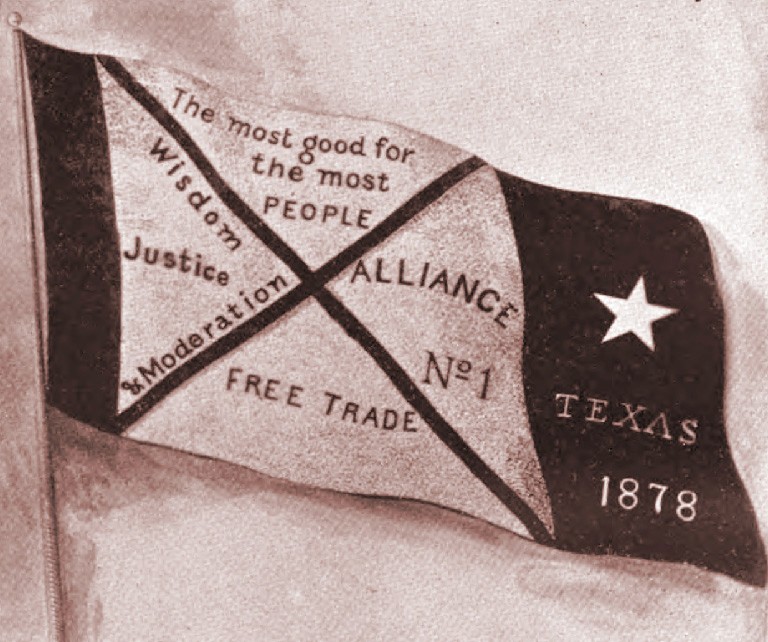
In response, in 1877, a group of farmers met in Lampasas, Texas, and from that meeting emerged the Southern Farmers’ Alliance, which was founded on the principle that, if farmers could bargain together, they could secure discounted goods for Alliance members based on wholesale prices. Local chapters negotiated agreements with merchants, and a similar arrangement was created for selling the farmers’ own products.
Clearly, Texas finds its roots in radical left-wing populism. So what went wrong? How did it go from being the home of one of the largest chapters of the Socialist Party in the United States to becoming such a stronghold for the right today? “In 2018, Ted Cruz held onto his seat not because he appealed to some deep-rooted Texan tradition—but because he overwhelmingly won among voters who had moved to Texas. Had the race been limited to only native Texans—that is, people born in the state—Beto O'Rourke would have won the native-Texan vote fifty-one percent to forty-eight percent. […] New Texans aren’t turning the state blue. They’re disproportionately voting Republican.” Despite this picture of the state we hold in our minds, Texas’s major cities are dominated by “centrists, liberals, progressives, and even Democratic Socialists competing for power in a manner similar to New York or California.”
The Myth of Red Texas opens with the following: “In blood-red states such as Texas, politics operates under the fallacy that these places were always conservative, and it would be foolish, even utopian, to propose a progressive alternative.” It goes on to detail how this belief ignores the state's history of left-wing movements and radical figures who challenged the status quo. Understanding the suppression of these movements is crucial to dispelling the myth of an inherently conservative Texas, a state that has a rich history of liberalism and radicalism. As Griscom said, the Republican Party has simply been skillful at crafting a version of Texas history that is favorable to its current goals.
Today, the media landscape is incredibly polarized, and for good reason. You should be concerned about what the Texas curriculum (known as Texas Essential Knowledge and Skills, or TEKS) is saying—and what it glosses over. In December of 2025, Texas Governor Greg Abbott launched a statewide partnership to establish chapters of the hard-right youth organization Turning Point USA in every public high school campus across Texas. According to the Texas Tribune, “Abbott said that he expects ‘meaningful disciplinary action' to take place against ‘any stoppage of TPUSA in the great state of Texas,’” and that “any school that stands in the way of a Club America program [the high school division of Turning Point USA] in their school should be reported immediately to the Texas Education Agency.” There is a lot to worry about, and, frankly, the Facebook moms are right: if you aren't angry, you aren't paying attention.
History is constantly being rewritten, and no longer can we afford to take it slow—without something to hold on to, we’ll be dragged out to sea by the rip current of change, and by the time we can tell whether it was in the name of progression or regression, any hope of regaining our footing will be as remote as solid ground beneath the open water.
[Capitol Construction], photograph, 1886~; (https://texashistory.unt.edu/ark:/67531/metapth124106/:accessed June 7, 2026), University of North Texas Libraries, The Portal to Texas History, https://texashistory.unt.edu; crediting Austin History Center, Austin Public Library.
Dietel, Norman. [Cattle Behind a Barbed Wire Fence], photograph, Date Unknown;(https://texashistory.unt.edu/ark:/67531/metapth64252/: accessed June 7, 2026), University of North Texas Libraries, The Portal to Texas History, https://texashistory.unt.edu; crediting LBJ Museum of San Marcos.