Imperialism is back, baby!
Written by
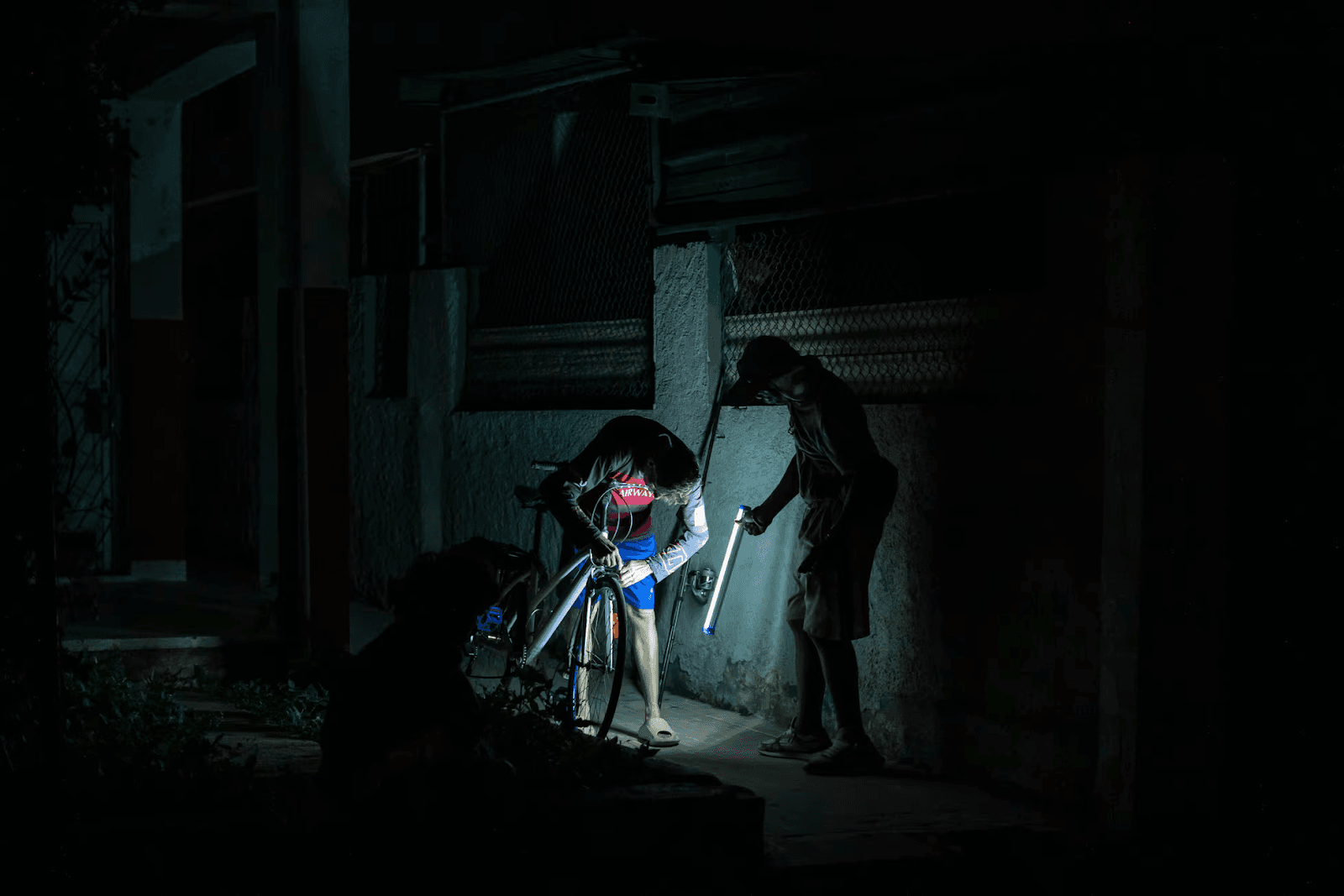
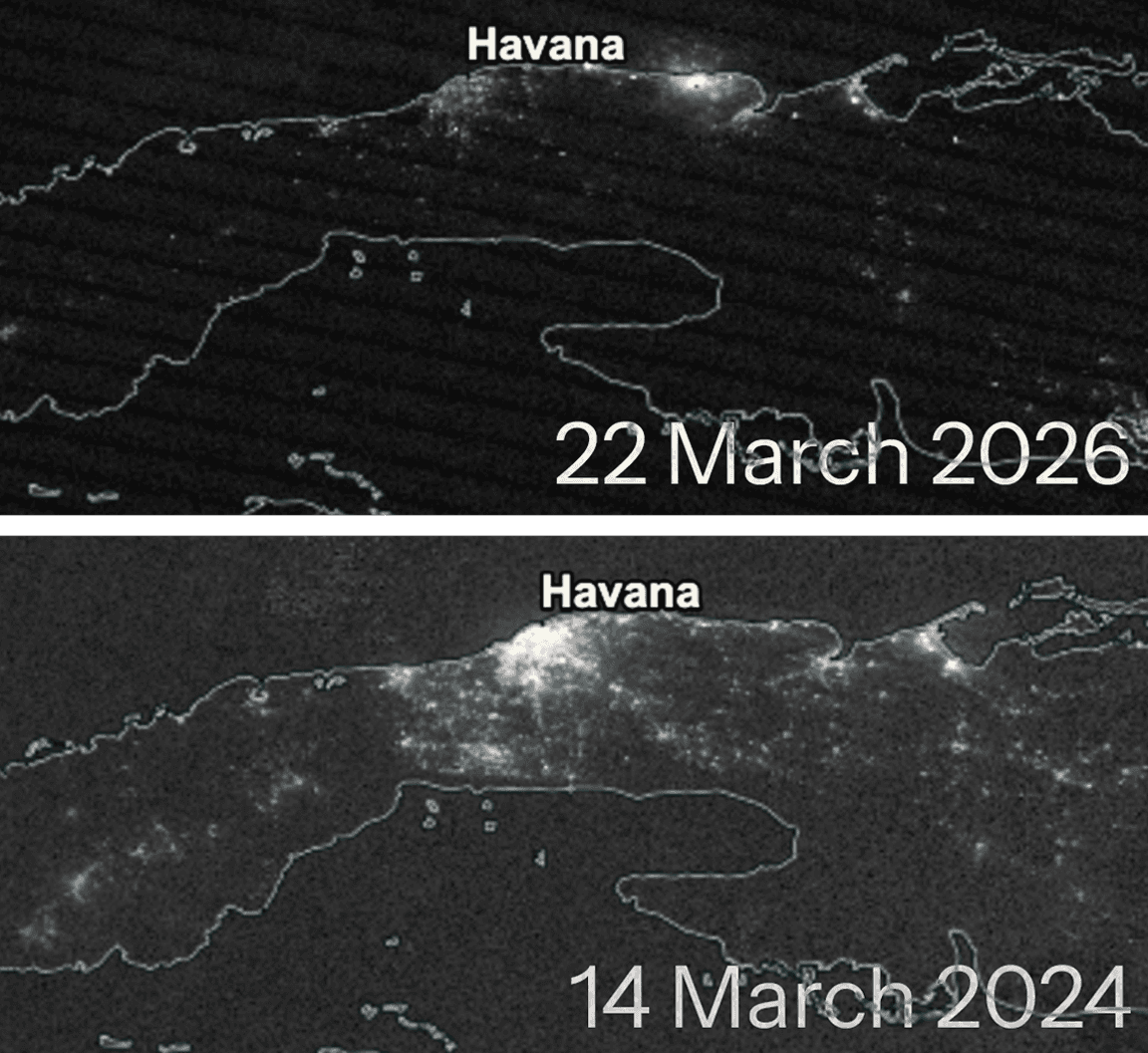
Cuba’s lights did not go out all at once, although the United States government did its best to accelerate the process, dedicating the better part of two months to exacerbating the island’s decades-long power crisis. The few lamps that still contain a glowing bulb are most likely running off solar, and black-market gasoline prices have ballooned to $40 a gallon. Cuba’s national grid has suffered three total collapses this March, with some outages lasting as long as thirty hours, leaving 10 million people trapped in darkness.
Cuba has now been starved of fuel for a full quarter. Venezuela once provided 61 percent of the energy supply, a pipeline that dried up when the U.S. launched an invasion at the start of last January that resulted in the capture of their President Nicolás Maduro, his wife, Cilia Flores, and the slaughter of eighty civilians and security personnel, with an explicit focus on gaining access to their oil revenue. Under Executive Order 14380, “Addressing Threats To The United States By The Government Of Cuba,” Trump has essentially declared a blockade of the Caribbean, threatening to impose heavy tariffs on any nation that dares to trade with the “extraordinary threat” of an island.
However, as of March 30, a Russian state-owned tanker carrying 730,000 barrels (100,000 tonnes) of crude oil—the Anatoly Kolodkin—was allowed through the blockade. It docked at Matanzas without interference from the two Coast Guard cutters stationed nearby, an unexpected break in the otherwise unrelenting siege on the island nation. Both Trump and his Press Secretary, Karoline Leavitt, shrugged it off, claiming, “if a country wants to send some oil into Cuba, I have no problem with that,” and “this is not a policy change.” These statements show that state decisions will now be made on a “case-by-case basis, depending on whether it benefits the United States. Anatoly Kolodin had already been previously sanctioned by the U.S., the EU, and the UK for carrying Russian oil following the country’s full-scale invasion of Ukraine. This is a dramatic double standard; the U.S. government cut Cuba’s people off from access to life-saving resources, then let a sanctioned Russian vessel through. Russia’s regime imposes a large-scale repression upon its people, is currently responsible for ongoing war crimes, and is inflicting a global pattern of aggression. Despite this, the Trump administration claims that Cuba and its communist government pose the greater threat to the U.S.’s freedom.
Press Secretary Leavitt declined to say whether the U.S. would allow future oil tankers to reach Cuba, failing to commit to a consistent standard. This suggests that the previous allowance may just be a product of Trump’s well-documented admiration of Russian dictator Vladimir Putin.
The President has been exceedingly vocal with his intentions. On March 16, 2026, he told reporters: “I do believe I’ll be having the honor of taking Cuba… whether I free it, take it, I think I can do anything I want with it, you want to know the truth. They’re a very weakened nation right now.” His quotes almost perfectly echo a sentiment shared by then-Assistant Secretary of the Navy, Theodore Roosevelt, who, too, once dreamed of colonizing Cuba (along with the greater Caribbean and Pacific), proclaiming, “I should welcome almost any war, for I think this country needs one.”
In fact, on March 16, he declared, “It’s a failed nation. They have no money, they have no oil, they have no nothing,” most certainly as a result of the United States government’s decades-long economic sanctions, which restrict trade, travel, and financial transactions, leaving 89% of Cubans subject to extreme poverty.
The human cost of this military conflict is measured in stalled surgeries and expiring medicine. Cuba’s universal healthcare system, once hailed as a great success in a country riddled with economic decline, is running on fumes. Thirty thousand children are at risk of death because the refrigerators keeping their vaccines alive could lose power at any minute. By the year’s end, 116,000 people—1 in 62 Cubans—will be waiting for surgeries that may never happen.
And even if they do get in to see a doctor, clinics are struggling to administer chemotherapy and dialysis, and blackouts can knock life support systems offline for several minutes before hospitals’ backup generators kick in. Dr. Alioth Fernandez, chief anesthesiologist at Havana’s largest pediatric hospital, told the New York Times, “I can’t tell you how many deaths [have occurred], but I’m sure there are more than in the same period last year.”
Antibiotics have vanished, resulting in extremely premature births and the death of three newborns in February. Infants are becoming malnourished amid skyrocketing food prices. This is a violation of both human rights and international law, perpetrated by the country founded on the principle that all people possess supposedly inherent, unalienable rights to life, liberty, and the pursuit of happiness.
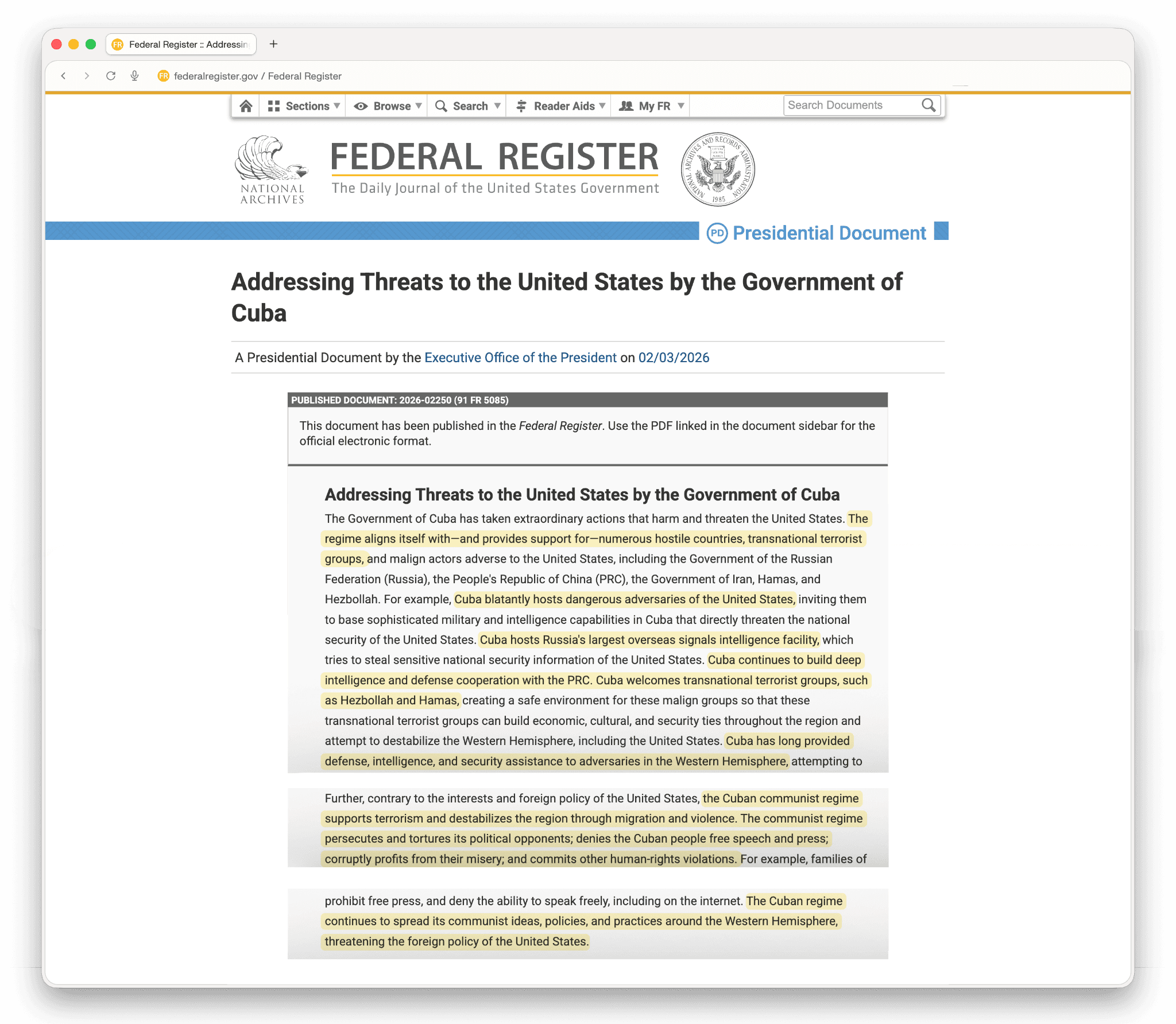
The State Department contends Cuba is an “unusual and extraordinary threat,” something United Nations experts describe as having “no basis in collective security and constitutes a unilateral act that is incompatible with international law.” Trump’s position on this issue is ironic, considering that as Havana starves, over $31 billion has been funneled to Israel to subsidize the genocide and ethnic cleansing of Gaza, the West Bank, and East Jerusalem since October 2023. Washington is eager to put boots on the ground to “save” Cuba from communism while simultaneously funding a (potentially) nuclear-armed apartheid ethnocracy that has committed atrocities not just within the Occupied Palestinian Territories, but in Lebanon, Syria, Iran, and Yemen, as well.
The executive order’s justification for U.S. attacks on Cuba is a plethora of McCarthyite tropes, labeling political enemies as communist threats using vague, unverifiable claims of foreign alignment, not evidence. Trump declared a “national emergency,” citing Cuba’s alignment with everyone from Russia to Hezbollah—claims that are contradicted by on-the-ground reporting. He lists human rights abuses like the denial of free speech and the harassment of worshippers, despite facing controversy in the United States for attempting to suppress speech by cracking down on pro-Palestinian protests, banning journalists from the White House for refusing to use his preferred term for the Gulf of Mexico, and publicly threatening to revoke the broadcast licenses of news agencies over negative coverage. Like McCarthy, Trump needs no proof; fear works just as well.
The Cuban state is undeniably an autocracy, but you cannot bomb or starve a population into loving democracy. The children in the intensive care unit are not the Cuban government.
Putting aside regime change, what does the Trump Administration truly want with the island? Per their own admission, they want to open it up for foreign investment. Deputy Prime Minister and Foreign Trade Minister Oscar Pérez-Oliva Fraga announced on March 16, 2026, that the island is “open to having a fluid commercial relationship with U.S. companies” and the Cuban diaspora and their descendants residing within the United States. As Jorge Castañeda told the LA Times, “the only way [Cuba’s government] can save itself is by doing everything on the economic front that Trump and the Miami people want them to do, in exchange for holding on to political power.” This is the standard American playbook. As summed up by Current Affairs, past administrations hated Castro not for his dictatorship, but for his nationalization of U.S. assets. They were perfectly content with what officials described as the “Gestapo” of Batista because he kept the money flowing. The welfare of the Cuban people was never a top priority.
When Trump said he believed he’d have “the honor of taking Cuba,” he was being more honest than any of his predecessors. Sixty-seven years of this policy of war have produced one consistent result: a more desperate Cuba, not a freer one. Their government has learned to survive by pointing to the United States as the source of its people’s suffering. Every blackout, every canceled surgery, every malnourished infant is a recruiting poster for the regime the United States claims to oppose. The U.S. is not liberating an oppressed people from a cruel government, it is creating their destruction.
Disagree with our framing? Pitch a counter-perspective.